Jason, Coming of Age
Play Jason, Coming of Age
Jason, Coming of Age Screenshots


















Jason, Coming of Age review
A player-focused walkthrough and analysis of JASON, Coming of Age
JASON, Coming of Age is an adult visual novel that follows a 25-year-old protagonist navigating relationships, choices, and personal growth—this guide dives into the game’s systems, narrative structure, and player strategies to help you get the most from your playthrough while highlighting key features from Episode 1 and later updates. In the following sections I share personal impressions, practical tips, and examples from my own time playing the game to illustrate how choices shape outcomes and which paths unlock the most content.
Core Gameplay and Mechanics
So, you’ve downloaded JASON, Coming of Age and you’re staring at the title screen, ready to dive into Jason’s world. 🎮 But this isn’t your typical click-through story. From the moment you hit ‘New Game,’ you’re not just a passenger—you’re the director, the social planner, and the heart of the narrative. The core JASON Coming of Age gameplay loop is a fascinating dance between making meaningful choices, managing your time and stats, and exploring a world that reacts to your every move. Let’s break down exactly how it all works and why it’s so compelling. 🤔
How choice-driven narrative works in JASON, Coming of Age
At its heart, JASON, Coming of Age is a choice-driven visual novel, but that phrase doesn’t do it justice. This isn’t about picking “Nice,” “Funny,” or “Romantic” replies. Your decisions here have weight, shape the world, and can literally redefine characters. We’re talking about a branching system so dynamic that entire scenes, dialogue threads, and even fundamental character properties are molded by your path.
The game remembers everything. Did you agree to help a classmate study? That might open up a whole new location later. Did you choose to be confrontational with a certain character? Their entire demeanor—and the story beats around them—might shift in response. I was genuinely stunned during one playthrough when, based on a series of earlier choices, a key character’s presentation and role in the story evolved in a way I never saw coming. It’s a powerful reminder that you’re not just following a script; you’re writing it.
Here’s a personal anecdote that drove this home for me. Early in Episode 1, you get a choice for your Saturday: attend a house party with some friends or go on a planned outing with a different group. 🤷♂️ I chose the party, thinking it was just a flavor scene. Wrong! That single choice locked me out of two entire time-stamped scenes with another character later that week, scenes that were crucial for building our rapport. The narrative didn’t just branch; it created parallel timelines of Jason’s life. This level of consequence is what makes the choice-driven visual novel mechanics here feel so rewarding and ripe for experimentation.
Time management, stats and the phone interface
Your most constant companion in JASON Coming of Age gameplay isn’t a love interest—it’s the in-game phone. 📱 This sleek interface is your command center, masterfully blending the game’s calendar, social hub, and stat tracker into one immersive device. The world operates on a time-stamped scenes system. Events, hangouts, and story beats are pinned to specific days and times. Your phone’s calendar shows you what’s coming up, creating a fantastic sense of anticipation and forcing you to make real trade-offs. You can’t be in two places at once!
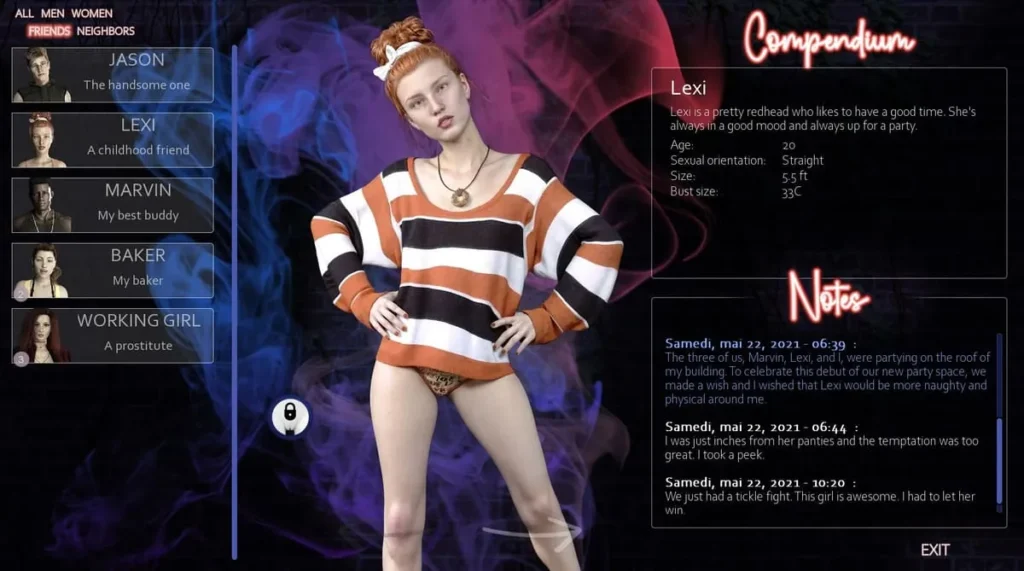
This is where strategy kicks in. Your choices feed into a web of stats and relationships tracked in the background. Want to know how you’re doing? That’s where the interaction statistics screen becomes your best friend. Accessed through the phone, this screen is a goldmine of data. It doesn’t just show vague “affection” meters; it breaks down your interactions with each character—how many times you’ve talked, chosen supportive options, or shared moments. You can see which relationships are thriving and which are languishing.
Let’s talk about how to use this intel. I once noticed my interactions with “Maya” were significantly lower than with “Chloe.” The interaction statistics screen made this imbalance crystal clear. So, on my next in-game day, I used my free time to seek Maya out and chose dialogue options I knew she’d appreciate. A few game-days later, that conscious rebalancing unlocked a tender, key animated scene that was previously inaccessible. The stats screen isn’t just for show; it’s a practical tool for narrative engineering.
To help you plan your social strategy, here’s a quick guide to how common decisions can ripple through the game:
| Your Action | Direct Outcome | Long-term Mechanical Effect |
|---|---|---|
| Choosing “Work on Project” over “Go to the Mall” | Immediate Intelligence stat boost. | Unlocks exclusive dialogue with a teacher later; may close off a chance encounter with a friend at the mall. |
| Spending “Free Time” with Alex instead of Sam | Direct scene with Alex plays. | Increases Alex’s specific interaction counter; may trigger a follow-up text message scene that evening. |
| Choosing a Flirty dialogue option with a love interest | Affection metric for that character rises. | Can shift the “tone” of your relationship, opening up more intimate conversation branches in future meetings. |
| Ignoring a character’s text message | No immediate scene. | Lowers that character’s “Connection” stat slightly; they may be less likely to initiate plans for a while. |
Free-roam segments, harem structure and replayability
Now, let’s get to the really fun part: the free-roam segments JASON is known for. These aren’t just breaks between visual novel segments; they are the sandbox where your curated story comes to life. 🗺️ During these periods, you can often explore your school or neighborhood, choosing who to talk to and where to go. This freedom is the engine of the game’s harem structure game design. You have multiple love interests and friends, all existing in the same space, and it’s up to you to decide who to pursue, befriend, or perhaps neglect.
This open approach turns Episode 1 into a fascinating narrative framework. It’s not a linear story with one ending; it’s a foundational setup for an open-world social experience. The Episode 1 replayability is through the roof. My first playthrough was a Chloe-centric romance. My second? I focused on building a wide circle of friends while subtly exploring a connection with Alex. The events of the episode played out in a dramatically different order, with entirely different emotional highlights, proving it’s a new story each time.
Here’s a micro case study from my own saves: I dedicated one playthrough almost exclusively to pursuing “Ethan.” I used the interaction statistics screen to ensure I never missed a chance to interact with him. This meant skipping other events and saying no to other characters. The payoff? Around the mid-point of the episode, a prolonged, intimate free-roam segment unlocked where we spent an afternoon alone together, culminating in a beautifully rendered animated scene that felt earned and deeply personal. That content was only there because of my focused prior choices.
So, what’s your game plan? Here’s some actionable advice from a fellow player:
- Save Often, Save Smart: ✨ Create multiple save slots at key decision points, especially before weekend plans or major story beats. You’ll thank yourself when you want to explore a “what if” scenario without replaying 10 hours.
- Embrace the Data: Use the interaction statistics screen proactively. Before a big in-game week, check it. See who you’ve been ignoring and make a conscious choice to engage with them.
- Experiment at the Start: Don’t be afraid to restart with different preference settings for Jason. These subtle shifts can change initial dialogue options and open up new avenues with different characters from the very first scene.
- Plan Your Sessions: Since the game uses time-stamped scenes, it’s easy to plan a play session around completing “a day” or “a week” in-game. It’s a satisfying way to experience the rhythm of Jason’s life.
A Quick Technical Note: As of this guide, the current version is the full release of Episode 1. You can find JASON, Coming of Age on both Steam and itch.io. The developer is active, so it’s always a good idea to check the official community pages or storefronts for any updates or patches that might add polish or new features.
Looking ahead, the mechanics established in Episode 1 are perfectly built for expansion. 🚀 The choice-driven visual novel framework, deep stat tracking, and free-roam segments create a scalable world. Future episodes can layer new characters, locations, and complex storylines onto the foundation you’ve already built with your Jason. The relationships you’ve nurtured and the stats you’ve grown will carry forward, making your journey feel continuous and uniquely yours. The sandbox is set, and it’s only going to get bigger and more detailed. Your choices, truly, are just beginning.
JASON, Coming of Age delivers a choice-rich, relationship-focused visual novel experience that rewards experimentation, careful time management, and deliberate save strategies. Use the playthrough tips and romance approaches above to explore multiple arcs, rely on the statistics screen and timestamps to guide decisions, and engage with community resources to stay current with updates and discoveries. If you enjoyed the practical tactics and personal examples here, try the recommended save plan on your next run and share your discoveries with the community so other players can benefit.